Automated TPV your customers can talk to

Automatdo runs your TPV calls with a voice agent that reads your approved script word for word and handles answers the way people give them. When an answer is not a clear yes, the agent rejects the verification, escalates it, or transfers the customer to a live person. Every call comes back as a recording and a structured result.

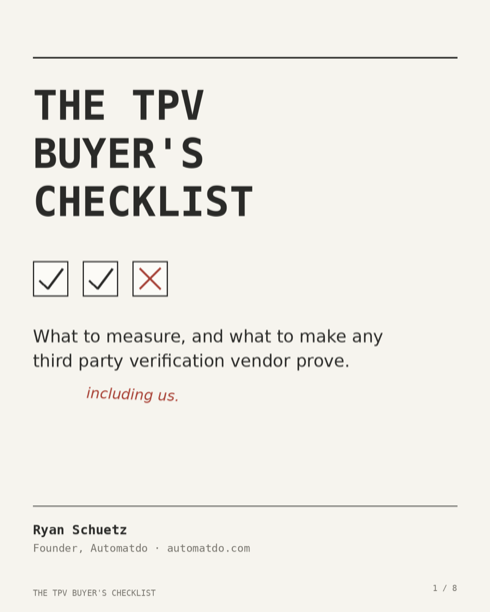
The TPV Buyer's Checklist

What to measure, and what to make any TPV vendor prove, including us.

The PDF downloads as soon as you submit.
Automatdo LLC
St. Paul, MN, USA
info@automatdo.com Privacy policy

Verification call Ended Illustrative
Energy enrollment Door to door ENR-10482
  1. Identity Confirmed
    “Yes, that’s me.”
  2. Service address Confirmed
    “Yes, that’s my address.”
  3. Plan and term Confirmed
    “Fixed rate, 12 months. Got it.”
  4. Price confirmation Disputed
    “No, he told me it would be less than that.”
  5. Authorization Not reached
Verification rejected
Stopped at price confirmation
Reason
Customer disputed the monthly price the rep quoted
Recording
Attached, full call
Next step
Order flagged in the CRM for sales follow-up
Illustrative example. Not a real customer or call.

What third party verification is

Third party verification (TPV) is a recorded call, separate from the sale, in which a verifier with no stake in the sale confirms who the customer is, what they agreed to, and the terms that matter to them. Its job is to produce evidence of consent that does not depend on the person who made the sale.

Whether you need TPV, and what the call has to cover, depends on what you sell, where, and through which channel. Telecom carrier changes have a federal rule. Energy rules are set state by state. Some companies verify where no rule requires it, because a recording of the customer's own words is hard to argue with when they later say they never agreed.

Four ways to run a TPV, and where each one breaks

Most programs run on one of these, and plenty run on two. Compare them on where verifications go wrong. A quoted price will not tell you that, because each model's failures land somewhere other than the invoice: in abandoned enrollments, in manual review, or in approvals that do not hold up.

Live agent, onshore

A domestic verifier reads the approved script and listens to the answers.

Strong at: judgment. A good verifier hears hesitation, slows down for a confused customer, and knows when to stop.

Where verifications go wrong: coverage and drift. Sales close in the evening and on weekends, and verification waits for a staffed seat. Over months, verifiers paraphrase to save time and the disclosures move away from the approved text. It is also the costliest of the four to staff.

Live agent, offshore or nearshore

The same scripted call, run from a lower-cost location. For high-volume programs this is the default.

Strong at: human judgment at volume.

Where verifications go wrong: queues at peak hours, turnover and retraining, and the match between the language of the sale and the language of the verification. Ask where the recordings are stored. With this model the answer can be another country.

Automated IVR

Recorded prompts. The customer presses a key or says one of a few fixed words.

Strong at: saying exactly the approved words, every time, at any hour.

Where verifications go wrong: real people. A customer who hesitates, answers in a full sentence, asks what a term means, or needs help either abandons or gets sent to a live verifier. A system listening for words can also hear the yes in “Yes, that is not correct” and pass a customer who just said no.

Conversational voice agent

An AI voice agent reads the approved script and understands natural answers.

Strong at: exact disclosures and a real conversation on the same call, without a queue.

Where verifications go wrong: improvisation. An agent that paraphrases a disclosure, answers questions outside the approved clarification paths, or keeps talking until a hesitant customer says yes produces approvals that will not survive a dispute. This is the model we build, so it is the failure we design against first.

One completion rate, three outcomes

Most TPV reporting leads with one number, a completion or pass rate. Three very different outcomes hide inside it, and each one needs a different response.

Abandonment

The call ends before a defensible decision. Some of these are valid customers lost to a queue or a rigid system. You want this low, and you want to know the exact step where people leave.

Rejection

The verification reached a substantive problem: the price, the customer's understanding of what they bought, or their authority to agree. That may be the verifier doing its job. A rejection rate near zero means the control never fires.

False pass

The report says confirmed. The recording says the customer did not agree. It counts as a success in every number the vendor shows you, it is the only one of the three that carries legal exposure, and vendor reporting cannot surface it. You find it by sampling your own approved calls and listening, or by working backward from disputes.

Manual review is a stage, not an outcome. Ask how long verifications wait there before someone decides.

You will never get to audit another client's calls, and you should not need to. The approvals on your own book are your records and your risk. Ask how you would go about auditing those.

What the Automatdo agent does on a call

Automatdo is a managed service rather than TPV software you configure yourself. We build the agent around your approved script, connect it to the systems your sales team already uses, and run it for you. On each verification:

  1. The order arrives from your CRM or sales platform, through an integration or our API, carrying the details the script has to confirm.
  2. The agent calls the customer, or answers when the customer calls in, and tells them they are speaking with an automated verifier.
  3. It reads every required disclosure word for word from your approved text. Questions get answers only from the clarification paths you have approved.
  4. It handles answers the way people give them: “yeah, that's right,” “wait, what was the cancellation part?”, a long pause, “my husband handles the bills.”
  5. When an answer is not a clear yes, it rejects the verification, escalates it for review, or transfers the customer to a live person. It does not coach anyone toward approval.
  6. You get the recording and a structured result: the outcome, the answer to each question, where and why a verification stopped, and timestamps. Results go back to your CRM or arrive by signed webhook.

If a customer needs a language your program does not cover, the verification stops and the result says why.

For engineers: the TPV Order API reference covers orders, outcomes and signed webhooks.

Five things to make any TPV vendor prove, including us

Ask every finalist for evidence on each of these. Then ask us. Our answer sits under each one, so you can hold us to it.

  1. Independence and regulatory fit

    Who controls the verifier, and what is it paid per? A verifier paid per confirmed enrollment has a financial reason to confirm. Then have each finalist show, rule by rule, how its workflow fits your footprint.

    Our answer: we are paid per attempt, whatever the outcome, so a rejection costs us nothing. Mapping our workflow to your states and sales channels is our job before you sign.

  2. Controlled script behavior

    Exact disclosures and approved clarification paths. With AI, ask how a change to the script, the prompt or the model is tested, approved and versioned before it reaches a customer.

    Our answer: disclosures are read from your approved text, and clarifications come from a list you sign off. Script changes are versioned and go live only after you approve them.

  3. Complete, portable evidence

    A recording, timestamps and a structured result for every attempt, including the ones that did not pass. How long they are kept, how fast you can retrieve one, the export format, and what happens to all of it if you leave.

    Our answer: every result arrives with its recording and the answer to each question, and you can pull any result again through the API. The records are yours, and they leave with you.

  4. Honest failure handling

    Silent, confused, coached or off-script customers get rejected, escalated or transferred. None of them get improvised toward approval.

    Our answer: each of those situations has a defined path, and the result records which path the call took.

  5. Operational resilience

    When the system degrades, does it stop approving or start approving? Failing open is worse than an outage.

    Our answer: when something upstream breaks, the agent stops approving and the verification comes back incomplete, so a fault shows up as missing approvals instead of bad ones.

For the full evaluation, with an edge-case demo to run before you sign, a weighted scorecard and the questions to put in a request for proposal, see how to choose a TPV vendor.

Questions buyers ask

What is automated third party verification?

It is a TPV call run by software instead of a live verifier. The older form is IVR: recorded prompts with keypad or one-word answers. The newer form is a conversational voice agent that reads the same approved script and understands answers given in ordinary speech. Either way the call is recorded and the result goes back to the seller's systems.

Is automated or AI TPV allowed?

For telecom carrier changes, the federal rule expressly allows automated third party verification systems, provided the verifier is independent of the seller, the call is recorded in its entirety, it runs in the language of the sale, and the customer can reach a live person at any time (47 CFR 64.1120). Energy rules are set state by state and can differ by sales channel. As of this writing we have not seen a regulator publish rules written specifically for AI verifiers, so map your own footprint and make every finalist show how its workflow fits each rule.

How is an AI voice agent different from IVR verification?

Both can read the approved disclosures exactly. The difference shows up when a customer does something the script did not plan for: hesitates, answers in a full sentence, asks what a term means, or says something that contradicts itself. An IVR can only accept the inputs it was built for, so those calls abandon or go to a live verifier. A voice agent can handle them within approved limits, and it has to be built so that it never improvises its way to an approval.

How much does automated TPV cost?

Most vendors in this category do not publish prices, and we do not either. The pricing model matters more than the number: a verifier that is paid only for confirmed enrollments has a financial reason to confirm. We price per attempt. To compare vendors, divide total program cost by retained, compliant enrollments.

What is a false pass in TPV?

A verification that the report marks as confirmed when the recording shows the customer did not agree. It counts as a success in every number a vendor shows you, and it is the only TPV outcome that carries legal exposure. You find false passes by sampling your own approved calls and listening, or by working backward from cancellations and disputes.

Can the customer ask for a live person?

Yes. Asking for a person is one of the agent's defined paths, alongside silence, confusion and suspected coaching. For telecom carrier changes, the federal rule requires automated systems to offer a live person at any time during the call.

What do we get back after each verification?

The recording and a structured result for every attempt, including the ones that did not pass: the outcome, the answer to each scripted question, where and why a verification stopped, and timestamps. Results are pushed to your system by signed webhook or written back to your CRM, and any result can be pulled again through the API.

Cover of The TPV Buyer's Checklist by Ryan Schuetz, Founder, Automatdo

The TPV Buyer's Checklist

Bring it to a vendor call: the number that matters, the nine numbers to make any vendor separate, the five things to make them prove, and the two questions that sort vendors fastest.

The PDF downloads as soon as you submit.
Automatdo LLC
St. Paul, MN, USA
info@automatdo.com Privacy policy

Talk to Ryan about your verification program

Tell me what you verify and roughly how many a month, and I will reply by email. If you would rather talk it through, pick a time on my calendar.

Pick a time on my calendar
Ryan Schuetz

Ryan Schuetz
Founder, Automatdo

Goes to Ryan directly, and only to reply to you.
Automatdo LLC
St. Paul, MN, USA
info@automatdo.com Privacy policy