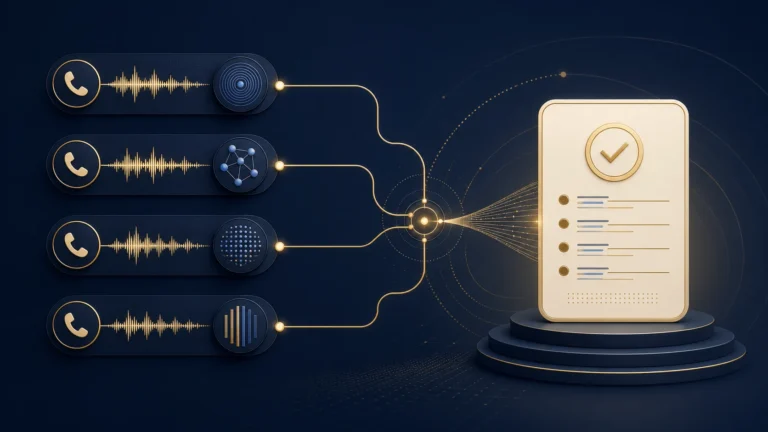
Third-party verification is the compliance step that energy retailers, solar installers, roofers, insulation companies, and telecom resellers treat as a necessary evil. It’s the legally required phone call where an independent voice confirms a customer actually authorized what your sales rep sold them — and if you get it wrong, you lose the enrollment, the commission, and sometimes your license.
The problem isn’t that TPV exists. The problem is how most businesses run it. Traditional TPV call centers charge $2–$5 per verification, drop 15–25% of eligible enrollments on the floor because of long hold times and rushed scripts, and leave you exposed when an auditor asks for a specific recording from 18 months ago. Most businesses just accept the bleeding.
This guide walks through what TPV actually is, which states require it, what must be captured on the call, how to avoid the compliance failures that get companies fined, and how AI is replacing the traditional call center model for businesses that want their verification to stop being a cost center. If you just want the short version: TPV doesn’t have to be expensive, slow, or painful — but most of the industry still treats it like it is.
What Is TPV Verification?
Third-party verification (TPV) is a recorded phone call where an independent verifier — not your sales rep, not your customer — confirms that a customer voluntarily agreed to a transaction. The “third party” is neutral. They don’t sell. They don’t persuade. They read a standardized script, ask the customer to confirm each material term, and create a recording that serves as the legal proof of consent.
TPV exists because regulators don’t trust self-interested parties to verify their own sales. When a customer signs up for a new electricity provider on their doorstep or over the phone, the regulator wants evidence that the customer actually understood what they agreed to — evidence that doesn’t come from the salesperson who closed the deal. An independent verification call creates that record.
If you’re new to the term, our glossary entry on third-party verification covers the definition in more depth. The short version: TPV is most common in regulated industries where door-to-door or phone sales are common — energy retail, solar, roofing, insulation, telecom, and insurance — and it’s required either by state regulators, industry codes of conduct, or both.
One important clarification: your buyer for TPV isn’t a call center. If you’re a roofer, solar installer, or energy retailer, you don’t operate a TPV call center — you hire one (or you automate one). The call center is the thing you pay. This guide is written for the people who pay for verification, not the ones who run it.
Why TPV Exists: The Regulatory Landscape
TPV became standard in the late 1990s and early 2000s, when states began deregulating electricity and natural gas markets. Suddenly, consumers could choose who supplied their power — and within a few years, regulators started seeing complaints about “slamming” (customers being switched to a new provider without authorization) and “cramming” (charges being added without consent). The response was to require independent verification of every enrollment.
The FCC’s telemarketing rules layered on similar protections for long-distance, cellular, and other telecom services. Today, verification requirements apply across multiple regulated industries — but the rules are inconsistent from state to state, which is where most businesses trip up.
State-by-State Overview
If you operate in a deregulated energy market, here’s the quick tour of the major regulated states. Always verify current rules with the regulator directly — they change.
| State | Regulator | Key Requirement | Retention |
|---|---|---|---|
| Texas | PUCT | TPV required for all Retail Electric Providers (REPs). Verbatim script language mandated. Enrollments without valid TPV can be reversed by the regulator. | 2 years minimum |
| Ohio | PUCO | Enrollment verification required for competitive retail electric and natural gas service. TPV must confirm understanding of rate, term, and cancellation rights. | 2 years minimum |
| Pennsylvania | PA PUC | Verification required within three business days of enrollment. Strict rescission notice and window requirements. Common audit target. | 3 years minimum |
| Illinois | ICC | Consumer choice program verification. Residential and small commercial enrollments require recorded consent. | 2 years minimum |
| California | CPUC | Strict language rules for energy and solar sales. Spanish-language verification required when the sale was conducted in Spanish. | 3 years minimum |
Even if you’re not in energy retail, similar consent requirements apply to door-to-door and phone sales in most industries. Solar installers frequently need TPV because their financing partners and state regulators require it. Roofing and insulation companies get pushed into verification programs when they work with utility rebate programs or storm-restoration insurance claims. Insurance brokers have their own consent rules under state insurance codes and federal TCPA regulations. Telecom resellers answer to the FCC.
The point: if you’re doing outbound or door-to-door sales in a regulated or insurance-adjacent industry, you probably need some form of independent verification — even if your state hasn’t written a specific TPV rule for your vertical.
Penalties for getting it wrong are not small. Fines typically run $1,000 to $25,000 per violation, and repeat failures can cost you the license you need to sell in a state. A single failed audit has ended small energy retailers.
What Must Be Captured in a TPV Call
The exact script varies by state and industry, but most compliant TPV calls capture the same core disclosures. Miss any of them and the recording isn’t valid.
- Customer identity. Full name, service address, and often an account number. The verifier confirms they’re speaking to the actual account holder, not a spouse or roommate without authority.
- Explicit authorization statement. The customer must say “yes” to a clear question like “Do you authorize [Company] to become your electricity supplier?” — not “I guess so,” not silence, not a nod the salesperson saw.
- Contract terms. The rate, the length of the contract, early termination fees, and any price variability. The customer confirms understanding, not just “sounds fine.”
- Third-party independence. The verifier must identify themselves as independent from the seller. This disclosure proves the call wasn’t coaching or persuasion.
- Rescission rights. In most states, customers have a cancellation window (typically 3–7 business days) and the verifier must explain how to use it.
- Language confirmation. If the sale happened in a language other than English, the verification has to happen in that language too.
“Verbatim” matters because auditors listen to recordings. When a regulator pulls a sample of your TPV calls for review, they’re checking whether the required language was actually spoken — not paraphrased, not summarized, not skipped because the verifier was in a hurry. A drifting script is one of the most common ways compliant programs become non-compliant over time.
Recording retention requirements typically run 2 to 3 years, and in some states longer. The recording has to be retrievable on demand, in a format the regulator can play, with metadata that lets you find the specific call for a specific customer. “Our old vendor went out of business and we lost the files” is not a defense.
Common TPV Compliance Failures
After looking at a lot of TPV programs, the same failure modes show up over and over. Here’s what breaks compliance — and how to stop it from breaking yours.
- Script drift. Verifiers get bored, start paraphrasing, and drop required disclosures without realizing it. Fix: monitor a random sample of calls weekly against the approved script. AI verification eliminates this failure entirely because the script can’t drift.
- Rushed verification. When verifiers are measured on call volume, they compress the script to save time. Customers feel pressured, say “yes” without understanding, and the recording still counts — until an auditor listens and flags it as coached. Fix: measure verifiers on accuracy and completeness, not call speed.
- Missing required disclosures. The verifier asks four questions but the script requires six. Often because the script was updated and the training wasn’t. Fix: version-control the script and force a re-read before every shift.
- Verifier prompting. The verifier leads the customer to the right answer (“You want to proceed with the enrollment, right?”). This voids the independence requirement. Fix: neutral phrasing only, and coach anyone who leans.
- Inability to produce records. The audit request comes in and nobody can find the recording. Either the vendor lost it, the storage system rolled off, or the customer record doesn’t link to the call. Fix: keep your own copy of every recording, tagged to the customer record, regardless of who operates the verification.
- Language barrier failures. Sale happened in Spanish, verification happened in English, and the customer confirmed everything they didn’t fully understand. This is a top audit finding in California and Texas. Fix: capture the sale language at the point of sale and route verification accordingly.
- Poor recording quality. Muffled audio, dropouts, or background noise that makes key phrases unintelligible. The regulator can’t verify what they can’t hear. Fix: test recording quality monthly and use equipment that actually captures clean audio on both sides.
How TPV Costs Add Up
Most businesses look at TPV as a line item — $2 to $5 per verification, paid to a call center — and stop there. That’s the cheap lie. The real cost of TPV includes everything verification steals from the business: enrollment drop-off, agent idle time fees, setup costs, monthly minimums, and compliance risk.
Let’s do the math for a typical energy retailer:
- Direct per-call cost: 1,000 enrollments/month × $3.50 per verification = $3,500/month
- Setup and account minimums: $500–$2,000/month regardless of volume
- Drop-off from hold times and poor UX: Industry average 15–25% of eligible enrollments fail TPV. At 20% drop and $150 lifetime customer value, that’s $30,000/month in lost revenue.
- Language and after-hours gaps: Customers who call outside business hours or who need Spanish-language verification get lost entirely.
The per-call fee is the smallest part of the problem. The drop-off is the killer. A 20% failure rate isn’t rare in traditional TPV — it’s the norm for high-volume programs with long hold times.
AI-based verification typically runs 80–90% cheaper per call than a human call center and eliminates hold times entirely. When a customer clicks through the sales flow, the verification starts immediately — no queue, no callback window, no “please hold for the next available verifier.” That alone cuts drop-off rates dramatically.
Traditional TPV vs AI TPV vs IVR TPV
There are three ways to run a verification program today. They’re not equivalent.
| Method | Per-Call Cost | Drop-Off | Script Adherence | Availability | Best For |
|---|---|---|---|---|---|
| Human Call Center | $2–$5 | 15–25% | Variable — drifts over time | Business hours | Very complex or disputed cases where empathy matters |
| IVR (phone tree) | $0.20–$0.80 | 30–50% | 100% rigid — no flexibility | 24/7 | Ultra-low-volume programs where cost is the only concern |
| AI Voice Agent | $0.30–$0.70 | 5–10% | 100% — script cannot drift | 24/7, every language | Any high-volume verification program |
The honest case for a human call center is still real for edge cases — complex disputes, rescissions that need empathy, elderly customers who need extra time. But for the routine verification of a standard enrollment, a human call center is the worst of all worlds: expensive, slow, and inconsistent. Most of the drop-off happens in the queue before anyone picks up.
IVR is cheap but brutal. Phone trees are the reason customers hang up. Any program that runs TPV through an IVR is bleeding enrollments to drop-off.
AI voice agents are the new option — and for most programs, they’re the obvious right answer. The agent sounds like a real person, reads the script exactly the same way every time, handles barge-in and clarification questions, speaks multiple languages on the same call, and never gets tired or rushed. The recording is automatically tagged, stored, and retrievable. The script can’t drift because the script is the agent.
The fair caveat: you still need a compliance-aware team configuring the agent. A great AI verification agent reading a bad script is still a bad TPV program. That’s why Automatdo’s done-for-you TPV service builds and maintains the script for you — because the thing that actually matters for compliance is the script, not the voice.
If you are evaluating providers rather than designing the program from scratch, use our TPV vendor evaluation framework to compare live agents, IVR, and conversational voice by compliant outcomes, evidence, escalation, and total program cost.
TPV Implementation Checklist
If you’re standing up a TPV program from scratch or auditing an existing one, here’s the order of operations that actually works.
- Map your state-by-state obligations. Start with the regulator in every state where you sell. Don’t trust last year’s memo — rules change. If you sell in Texas, Ohio, and Pennsylvania, you have three different rule sets to comply with.
- Get a compliant script approved by legal or a compliance consultant. The script is the product. Every required disclosure must appear, in the right order, in plain language the customer can understand. Don’t copy a competitor’s script — they may be wrong, and you’ll inherit their mistakes.
- Choose your verification method. Human call center, IVR, or AI voice agent — pick based on your volume, your margin, and your compliance appetite. For most programs above 200 enrollments/month, AI wins on both cost and compliance.
- Test with real scenarios before going live. Run 50 verifications in a test environment with representative sales flows. Listen to every recording. Confirm the script was followed. Fix the gaps.
- Set up recording storage and retention. Every call goes into a system that tags it to the customer, timestamps it, and retains it for at least 2 years (3+ in Pennsylvania and California). You should be able to pull any recording in under five minutes if an auditor asks.
- Monitor drop-off and script adherence weekly. Drop-off rate is your business metric. Script adherence is your compliance metric. Both should be on a dashboard someone looks at every week.
- Prepare for audits before they happen. Know where every recording lives. Document your compliance process. When the regulator sends a records request, you have 30 days to respond — not 30 days to start organizing.
If this list reads like a part-time job, that’s because running a compliant TPV program traditionally is a part-time job. That’s why most businesses either pay a call center way too much or cut corners that bite them at audit time. The AI TPV model changes the economics — if you go the AI route, a good done-for-you vendor handles steps 2 through 7 for you. You just confirm the script says what you want it to say.
Frequently Asked Questions
What is TPV verification?
TPV (third-party verification) is a recorded phone call where an independent verifier confirms that a customer voluntarily authorized a transaction — typically an energy enrollment, solar installation, telecom service change, or insurance policy purchase. The verifier is neutral: they don’t sell, they don’t persuade, they read a compliant script and capture the customer’s explicit consent on a recording that serves as legal proof.
Is TPV required by law?
Yes, in many cases — but it depends on the industry and state. In deregulated energy markets (Texas, Ohio, Pennsylvania, Illinois, California, and others), state regulators require TPV for every residential and small-commercial enrollment. The FCC requires verification for certain telecom services. In industries without a direct state mandate (like solar and roofing), TPV is often required by financing partners, utility rebate programs, or industry codes of conduct. If you do door-to-door or phone-based sales in a regulated space, you almost certainly need some form of verification.
How much does TPV cost?
Traditional human TPV call centers charge $2 to $5 per verification, plus monthly minimums of $500 to $2,000. The real cost is higher because 15–25% of enrollments drop during verification — so you’re paying for the call and losing the customer. AI voice agent verification typically costs $0.30 to $0.70 per call with no queue, cutting both the per-call cost and the drop-off rate.
How long must TPV recordings be kept?
Retention requirements vary by state. Most require a minimum of 2 years. Pennsylvania and California require 3 years or longer. Best practice is to keep recordings for at least 3 years regardless of state to cover potential disputes and regulatory lookbacks. Recordings must be retrievable on demand, tagged to the customer, and playable in a format the regulator accepts.
Can AI replace a TPV call center?
For most programs, yes. AI voice agents read compliant scripts with 100% adherence, handle verification 24/7 without hold times, speak 50+ languages on the same number, and store recordings automatically. They eliminate script drift, queue drop-off, and human rush-induced failures. The cases where a human is still better are narrow: complex disputes, rescissions that need empathy, and certain elderly or cognitively impaired customers who need more time. For routine verification of a standard enrollment, AI is both cheaper and more compliant than a human call center.
Which states require TPV for energy?
The major deregulated energy states with explicit TPV requirements include Texas, Ohio, Pennsylvania, Illinois, California, New York, New Jersey, Connecticut, Maryland, Massachusetts, Rhode Island, and Washington D.C. Rules vary — Texas and Pennsylvania have some of the strictest script and rescission requirements. Always check with the state’s public utility commission for current rules before launching.
Making TPV Suck Less
TPV doesn’t have to be expensive, slow, or painful. Most of the cost and most of the drop-off comes from running verification the way it’s always been run — through a human call center that charges too much, works only during business hours, and fails audits because the script drifted. The technology to do it better exists. Most businesses just haven’t switched yet.
If you’re running a TPV program and you’re tired of the cost, the drop-off, or the audit anxiety, that’s what we do. Automatdo builds done-for-you AI TPV for energy retailers, solar installers, roofing companies, and other regulated industries. We write the script, train the AI voice agent, connect to your enrollment system, store the recordings, and handle the compliance reporting. You tell us what state you’re in and what you sell. We deliver a working TPV program in about a week.
You don’t configure anything. You don’t learn a platform. You don’t manage a call center. You just get verified customers and clean audit trails.
See how it works on our TPV solutions page, check pricing, or book a 15-minute call and we’ll show you what your program would look like.
Related Reading
- Third-Party Verification (Glossary) — full definition and related terms
- TPV Call Center (Glossary) — how traditional TPV call centers work and what they cost
- Automatdo TPV Solutions — our done-for-you AI TPV service
Ready to automate your TPV verification?
See how Automatdo's AI voice agents can reduce costs and improve compliance.
Book a Demo